AI Chatbot vs. Live Chat: Which Is Right for Your Business?
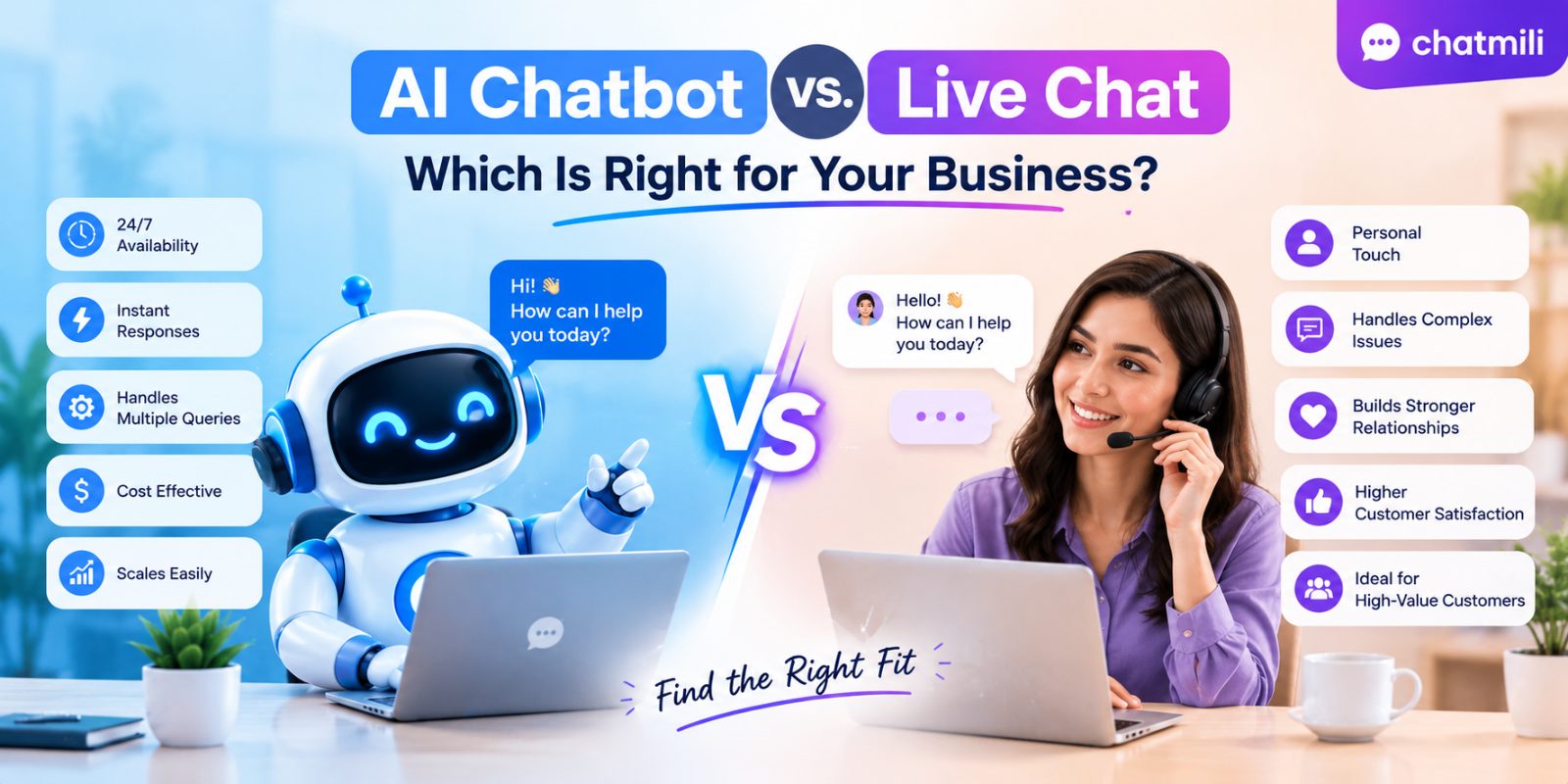
"Live chat" and "AI chatbot" get used almost interchangeably, but they solve different problems. Understanding the difference will save you from picking the wrong one — or from assuming you have to choose only one.
What live chat actually is
Live chat is a real person, typing in real time, through a chat widget on your website. It's genuinely great at handling nuanced, high-stakes conversations — but it only works while someone is actively watching the window. Outside those hours, live chat is just a form that says "leave a message."
What an AI chatbot actually is
An AI chatbot reads your business's knowledge, understands what a customer is asking in natural language, and replies instantly — 24 hours a day, on as many conversations at once as arrive. It can also perform actions: booking an appointment, checking product availability, or qualifying a lead, not just answering questions.
Head-to-head comparison
| Live Chat | AI Chatbot | |
|---|---|---|
| Availability | Only when staffed | 24/7 |
| Response time | Depends on staff availability | Instant |
| Cost to scale | Grows with message volume | Mostly fixed |
| Handles nuance/complaints | Excellent | Limited — should escalate |
| Consistency | Varies by person | Same every time |
| Can take actions (booking, orders) | Only if the person does it manually | Yes, automatically |
The honest answer: most businesses need both
The strongest setup isn't "AI chatbot instead of live chat" — it's an AI chatbot that handles the instant, repetitive first response and hands off to a human the moment a conversation needs real judgment: a complaint, a refund request, or anything outside its knowledge. This is sometimes called a live-agent handoff, and it's the feature to look for when choosing an AI chatbot platform.
Done well, your team only ever sees the conversations that genuinely need them — with the full chat history already there, so the customer never has to repeat themselves.
When to lean more toward pure live chat
If your business handles almost entirely complex, high-stakes, or highly personal conversations (certain legal or medical contexts, for example), and volume is low enough that a person can realistically cover it, live chat alone can still make sense — though even then, an AI can usefully cover after-hours messages.
When to lean more toward AI-first
If most of your inbound messages are repetitive — hours, pricing, availability, booking — and volume is high enough that staffing live chat around the clock isn't realistic, an AI-first setup with human escalation is almost always the better economics.
Curious what this looks like in practice? Read what an AI receptionist actually does or compare ChatMili's plans.